
 English
 Deutsch
 Español
 Français
 Беларуская

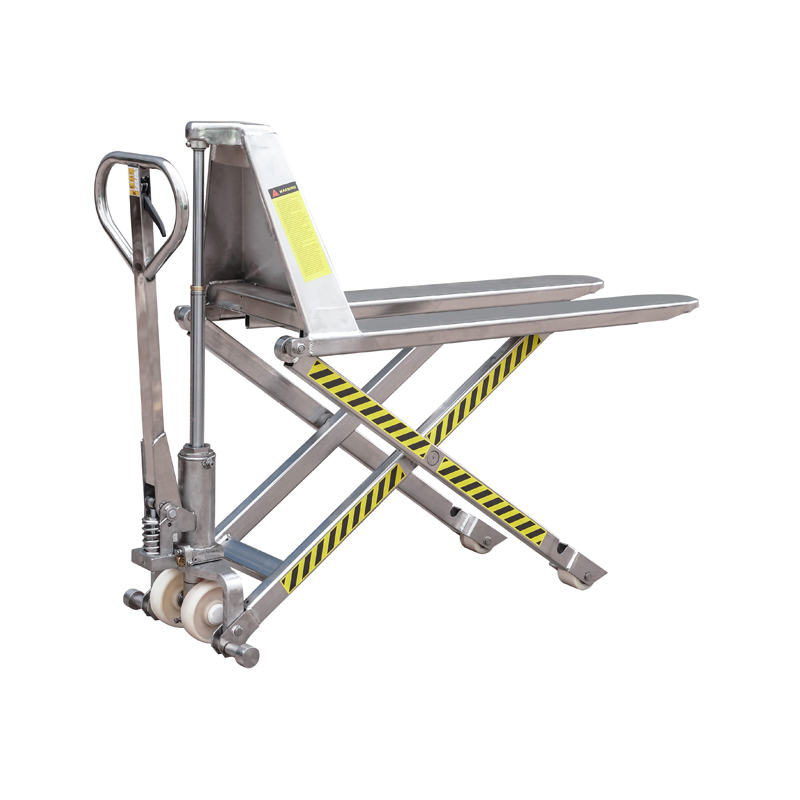
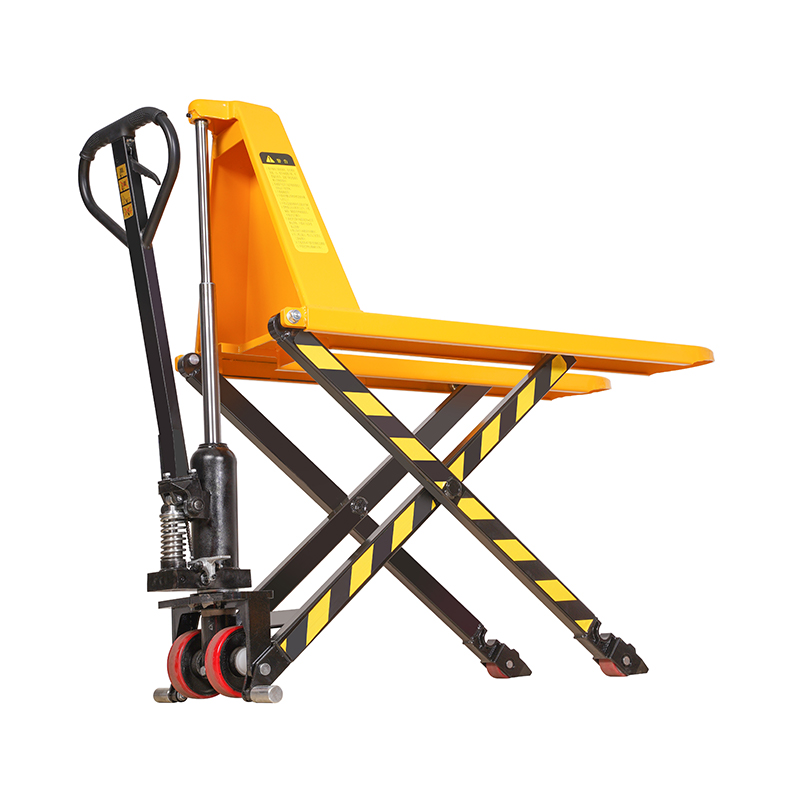
A scissor high lift pallet truck is a specialized hydraulic handling device built with scissor lift mechanisms, mainly applied to lift palletized cargo to elevated heights for daily industrial operations. It combines the mobility of standard pallet trucks and the lifting capacity of scissor lifts, making it ideal for warehouses, production workshops, logistics centers and retail storage areas. This equipment replaces repeated manual lifting, effectively lowering labor intensity and reducing the risk of workplace injuries. Most models support stable lifting within a common height range, and they work well for order picking, goods stacking, assembly line feeding and loading auxiliary work. Compared with large lifting equipment, it features flexible movement, low operating cost and no strict site requirements, so it has become a mainstream auxiliary tool for medium and light load handling scenarios.
Basic Structure and Working Principle
Main Structural Components
The overall structure of a scissor high lift pallet truck is compact and reasonable, and every part is designed around mobility and lifting stability. The whole device can be divided into multiple core parts, and each component undertakes independent functions while cooperating closely with each other.
- Pallet fork: The bearing part for carrying pallets and goods, with reinforced structure to ensure load-bearing stability during lifting and moving.
- Scissor lift frame: The key lifting component, adopting interlaced scissor arm design, which stretches and retracts to realize height change.
- Hydraulic system: Provides power for lifting, including hydraulic cylinder, oil pipe and control valve, controlling the rising and falling speed.
- Walking wheels and steering mechanism: Ensures flexible movement in narrow passages, easy to turn and position.
- Operating handle: Integrates lifting, lowering and walking control, simple for operators to master.
How the Equipment Works
The working logic of this pallet truck is based on hydraulic transmission and mechanical linkage. When the operator manipulates the lifting handle, the internal hydraulic pump starts to work, pushing hydraulic oil into the cylinder. The hydraulic rod extends outward to drive the scissor frame to expand upward, and the pallet fork carrying goods rises steadily. When lowering goods, release the control valve, the hydraulic oil flows back slowly, and the scissor frame retracts under the weight of goods and its own gravity, so the fork returns to the lowest position. The hydraulic buffering design can avoid sudden drop of goods, which greatly improves operation safety. In the walking state, the scissor frame keeps retracted, and the whole vehicle moves like an ordinary pallet truck, which will not affect the passing ability in narrow channels.
Core Advantages and Applicable Scenarios
Key Advantages Over Ordinary Handling Tools
In practical industrial application, scissor high lift pallet trucks show obvious advantages compared with traditional low-lift pallet trucks and large fixed lifting platforms. These advantages are reflected in flexibility, economy and practicality.
| Equipment Type | Lifting Height | Mobility | Use Cost |
|---|---|---|---|
| Scissor High Lift Pallet Truck | Medium to high | High | Low |
| Standard Low-lift Pallet Truck | Low | High | Low |
| Fixed Lifting Platform | High | Poor | Medium |
First of all, it realizes the integration of walking and high lifting. Ordinary pallet trucks can only lift goods off the ground slightly for moving, and cannot meet the height demand for picking and stacking. Secondly, it has strong adaptability to sites. It can pass through narrow warehouse aisles and small workshop spaces where large equipment cannot enter. Thirdly, the operation threshold is low. Workers can get started after simple training, without professional operating certificates for large mechanical equipment. In addition, the overall failure rate of the hydraulic structure is low, and daily maintenance is simple, which can keep stable operation for a long time under continuous working conditions.
Typical Application Scenarios
This type of pallet truck is widely used in multiple industrial fields, and its functions can be fully exerted in different working links.
- Warehouse order picking: Lift palletized goods to the comfortable working height of staff, avoid frequent bending and climbing, and improve picking efficiency.
- Production workshop feeding: Transport raw materials and semi-finished products to assembly stations, and lift them to the operating height of production lines to assist assembly work.
- Goods stacking and sorting: Stack pallet goods at a certain height, and sort scattered goods on the elevated pallet for subsequent distribution.
- Logistics transit assistance: Cooperate with loading and unloading work at transit points, adjust the height to match the cargo compartment, and reduce the difficulty of handling.
Standard Operating Steps and Safety Rules
Standard Operating Process
Standardized operation is not only to ensure work efficiency, but also the basis for protecting equipment and operators. The complete operation process is divided into preparation, loading, moving, lifting, lowering and parking links.
- Pre-operation inspection: Check whether the hydraulic part leaks oil, whether the wheels rotate flexibly, and whether the scissor frame has stuck parts. Do not use the equipment with abnormal conditions.
- Loading goods: Align the pallet fork with the pallet gap, push the fork fully into place, ensure the goods are placed in the middle to avoid unbalanced load.
- Low-position moving: Lift the goods slightly off the ground, hold the operating handle to push the vehicle forward or backward, and slow down when turning.
- Lifting operation: Stop the vehicle on a flat ground, operate the lifting handle to raise the goods to the required height, and lock the position if equipped with a locking device.
- Lowering and unloading: After finishing work, slowly lower the goods to the lowest position, then pull out the pallet fork to complete unloading.
- Parking work: Park the equipment in the designated area, retract the scissor frame completely, and place the handle in a fixed position.
Important Safety Specifications
There are clear safety norms in the use of scissor high lift pallet trucks, and violation of rules will easily lead to goods tipping, equipment damage or personal injury. Overloading is the most common unsafe behavior and must be strictly prohibited. Each device has a rated load, and long-term overloading will damage the hydraulic system and scissor structure.
In addition, do not operate the lifting function when the vehicle is moving at a high speed, and do not turn sharply when the goods are in a high lifting state. The equipment must work on flat and solid ground; soft ground, slope and uneven ground will cause the vehicle to tilt. Operators shall stand on the side of the equipment during operation, never stand under the lifted goods to prevent accidents caused by sudden falling. When transporting oversized goods, ensure that the goods do not exceed the width of the pallet fork, and bind the scattered goods properly to prevent falling during moving.
Daily Maintenance and Troubleshooting Tips
Routine Maintenance Work
Good daily maintenance can effectively extend the service life of scissor high lift pallet trucks and reduce failure frequency. Maintenance work can be divided into daily inspection, regular lubrication and regular hydraulic oil replacement.
- Daily cleaning and inspection: Clean the dust and sundries on the scissor frame, wheels and hydraulic parts every day, and check for oil leakage and component deformation.
- Regular lubrication: Add lubricating oil to the rotating shafts and connecting parts of the scissor frame and walking wheels periodically to keep the movement smooth and avoid jamming.
- Hydraulic system maintenance: Replace the internal hydraulic oil regularly according to the use frequency, and clean the oil filter to ensure the hydraulic power is sufficient.
- Storage management: When not in use for a long time, park it in a dry and ventilated area, avoid rain and moisture erosion, and fully retract the scissor frame to keep the components in a relaxed state.
Common Minor Faults and Solutions
In the long-term use process, some minor faults may appear. Most common problems can be solved through simple adjustment and maintenance without professional repair personnel.
If the lifting speed becomes slow or cannot be lifted normally, it is mostly caused by insufficient hydraulic oil or blocked oil pipes. Supplement qualified hydraulic oil first, and check whether the oil pipes are squeezed or blocked. If the goods sink automatically after being lifted, it means the internal control valve is not sealed tightly, and the valve assembly needs to be checked and adjusted. When the scissor frame is stuck during stretching and retracting, clean the sundries at the connecting parts and add lubricating oil. If the walking wheels are stuck, check whether foreign matters are wrapped around the wheel shaft and remove them in time. For complex structural damage, stop using immediately and arrange professional maintenance instead of disassembling privately.