
 English
 Deutsch
 Español
 Français
 Беларуская

Content
- 1 How a Scale Pallet Truck Measures Weight
- 2 Before You Calibrate: Preparation and Safety Checks
- 3 Step-by-Step Calibration Procedure
- 4 Troubleshooting Weight Reading Errors
- 5 Environmental and Application Factors That Distort Readings
- 6 Maintenance Schedule for Reliable Weight Readings
- 7 Repair, Recalibrate or Replace?
- 8 Frequently Asked Questions
- 8.0.1 Q1: How often should a scale pallet truck be calibrated?
- 8.0.2 Q2: Can I calibrate a weighing pallet truck without certified test weights?
- 8.0.3 Q3: Why does my scale read differently at the fork tips than in the centre?
- 8.0.4 Q4: What does three-proof mean on a weighing pallet truck?
- 8.0.5 Q5: Why does the reading change when the battery is low?
A weighing scale pallet truck turns every lift into a weighing event, removing the extra trip to a floor scale and the double handling that goes with it. The gain disappears the moment the display starts to drift: an error of 3 kg across 500 pallets is 1.5 tonnes of unexplained stock, and no operator keeps trusting an instrument that disagrees with itself.
Most weight reading errors on scale pallet trucks come from a short list of causes: a zero point set on an uneven floor, a span calibration performed with an unverified weight, a load cell cable pinched by the fork linkage, or a battery that sags under load. This guide explains how these scales measure weight, how to calibrate a weighing pallet truck properly, and how to troubleshoot the reading errors that survive a calibration. If you are still weighing up the investment, the operational benefits of weighing at the point of use are a good place to start.
How a Scale Pallet Truck Measures Weight
A weighing pallet truck is a hydraulic pallet truck with a measuring chain added to it. Strain gauge load cells sit between the fork frame and the chassis, or inside the fork frame, and convert mechanical load into a millivolt signal that the indicator turns into kilograms. Some designs read hydraulic pressure in the pump cylinder instead. Whatever the sensing method, three values decide whether the number on the display can be trusted.
Repeatability matters more than absolute accuracy. A truck that reads 502 kg every time for the same 500 kg pallet can be corrected with a span adjustment; one that reads 498, 506 and 501 kg for the same load has a mechanical or electrical fault that no calibration will repair. Rated capacities and indicator functions for specific models are listed in the weighing scale pallet truck brochure.
Before You Calibrate: Preparation and Safety Checks
Calibration is only as good as the conditions it is performed in. Work through this checklist first.
- Power. Charge the truck or connect a stable supply; a low battery is a leading cause of drifting displays.
- Floor. Use a level, solid slab rather than a dock plate or a ramp.
- Machine state. Park unladen with the forks fully lowered and the handle in neutral.
- Warm-up. Let the indicator stabilise for 10 to 15 minutes so thermal drift settles.
- Mechanical condition. Clear debris from the fork frame and load cell area, and check the forks for bending or cracks.
- Hydraulics and cables. Check oil level and leaks, then inspect the load cell cable for cuts and pinches and reseat every connector.
- Test weights and records. Have certified weights near 20 to 30% and 60 to 100% of rated capacity, plus the manual, the calibration code and the previous record.
Step-by-Step Calibration Procedure
Key sequences differ between indicators, so follow the manual for entry. The measurement logic below applies to almost every weighing pallet truck.
- Record the rated capacity and graduation from the nameplate.
- Switch on with the forks empty and lowered, and let the indicator settle.
- Enter calibration mode using the manufacturer's key sequence or access code.
- Set the zero point with the forks empty; if zero will not hold, clean the frame and check for residual hydraulic pressure before continuing.
- Apply a certified weight of about 20 to 30% of capacity, centred between the forks, and enter that value as the first span point.
- Apply a second weight of 60 to 100% of capacity, keep it centred, and enter that value.
- Save, exit calibration mode and power cycle the indicator.
- Verify linearity with at least three loads across the range, for example 25%, 50% and 100% of capacity.
- Verify repeatability by weighing the same pallet five times, unloading and reloading between readings.
- Verify off-centre loading by placing a weight at the left fork tip, the right fork tip and the centre.
- Log the date, the weights used, the results and any adjustment made.
Never calibrate with a weight you merely assume is correct. A bag of resin, a known pallet or a borrowed counterweight will copy its own error into the scale, and every later reading will repeat that error.
Troubleshooting Weight Reading Errors
Isolate faults in this order: mechanical first, electrical second, calibration last. Recalibrating a truck with a distorted fork frame or a corroded connector simply hides the fault behind new numbers.
| Symptom | Most likely cause | First action |
|---|---|---|
| Reading drifts upward with no load | Thermal drift, moisture in a connector, residual hydraulic pressure | Warm up, re-zero, dry and reseat connectors |
| Display jumps or flickers | Low battery, loose load cell cable, vibration | Charge or replace the battery, check every connector |
| Reading low or high by a fixed percentage | Span error or a wrong value entered at calibration | Repeat the span calibration with certified weights |
| Different result for the same pallet | Mechanical binding, worn load cell, distorted fork frame | Inspect the mechanics before recalibrating |
| Error code or dashes on screen | Overload event, or sensor and indicator fault | Test empty, then follow the manual's fault list |
| Correct in the centre, wrong at the tips | Off-centre loading or corner sensitivity | Run a corner load test and inspect the fork frame |
| Correct when stationary, wrong while rolling | Dynamic and vibration effects | Weigh stationary with the forks lowered |
If a fault returns within days of a calibration, the calibration was not the problem.
Environmental and Application Factors That Distort Readings
Temperature and Thermal Drift
Load cells are temperature-compensated, but compensation has limits. A truck moved from a cold dock into a heated warehouse can drift for the first 15 to 20 minutes, which is why a warm-up period belongs inside every weighing routine.
Moisture, Washdown and Corrosion
Water and dust reach the indicator, connectors and load cell long before they reach the hydraulics. In food, chemical and cold storage areas, specify a three-proof truck with water, dust and corrosion resistance rather than trying to protect a standard unit.
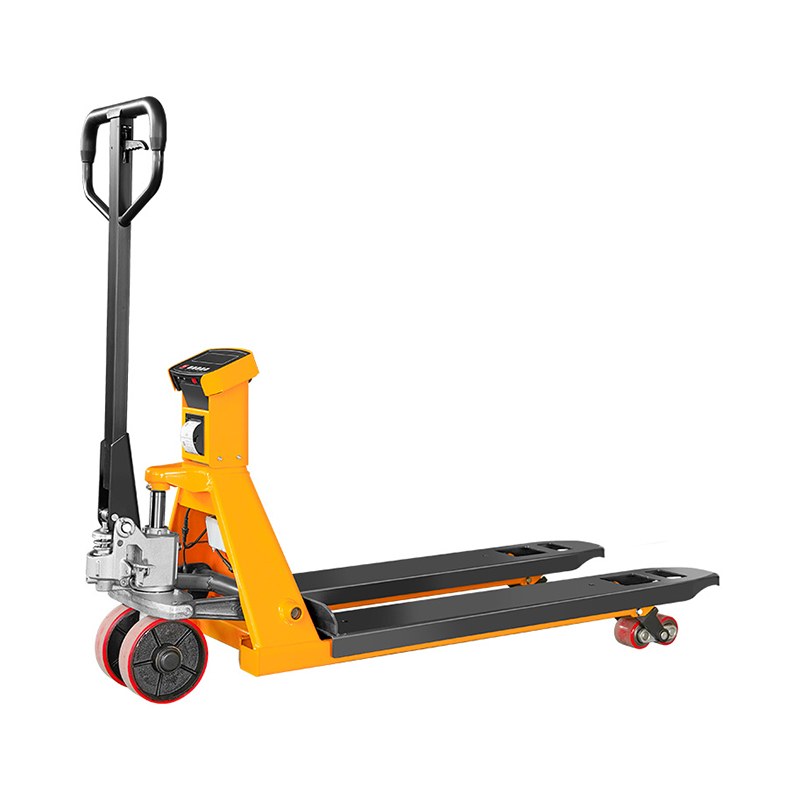
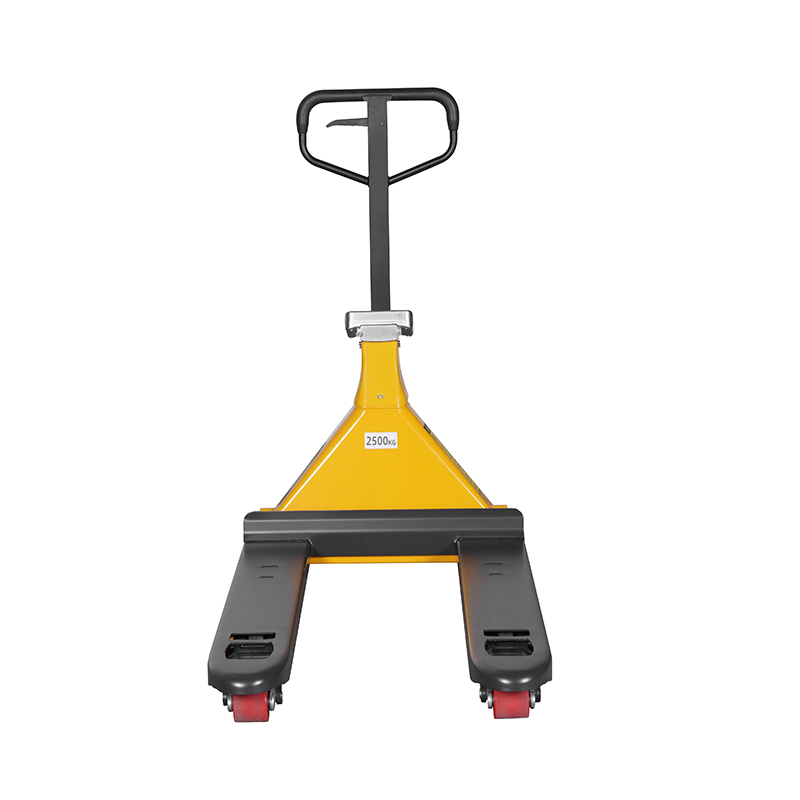 PSD20 Three-Proof Weighing Pallet Truck with Modular IndicatorFor food, chemical, and cold storage areas needing water, dust, and corrosion resistance, this customizable truck combines transport, weighing, and counting with plug-and-play instrument replacement.View Product →
Uneven Floors, Slopes and Off-Centre Loads
A sloping floor loads the forks unevenly and shifts the centre of gravity of the load. Weigh on the flattest surface available, keep pallets centred between the forks, and never take a reading while the truck is rolling.
Maintenance Schedule for Reliable Weight Readings
| Interval | Task |
|---|---|
| Every shift | Check the charge level, inspect cable and indicator, confirm zero with empty forks |
| Weekly | Clean the fork frame and load cell area, check hydraulic oil and leaks, inspect wheels |
| Monthly | Verify zero and one known load, tighten fasteners, inspect connectors for corrosion |
| Every 6 to 12 months | Full calibration with certified weights and comparison with the previous record |
| After repair or impact | Recalibrate immediately after any fork, load cell or hydraulic work |
Repair, Recalibrate or Replace?
Replace the sensing chain when a truck fails repeatability and corner tests after a correct calibration, when the indicator has no spare parts, or when the accuracy you need is finer than the display can hold. Electric weighing trucks suit high-throughput dispatch and dock work, where the operator weighs and moves in a single pass.
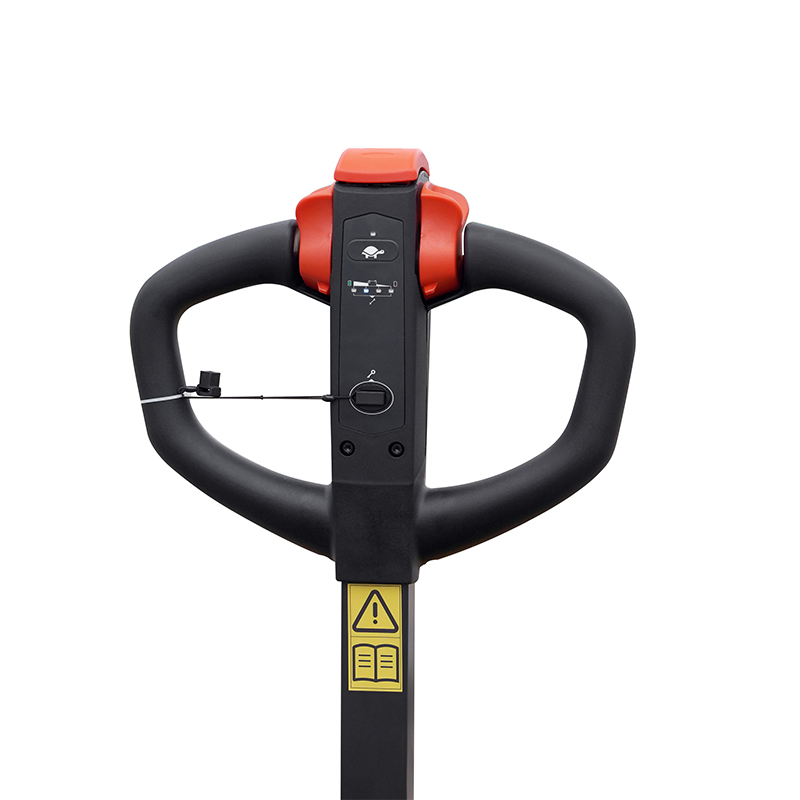 CBD-C Electric Weighing Pallet Truck for High-Throughput DispatchFor high-throughput dispatch and dock work, this fully electric truck lets operators move and weigh pallets in one pass with waterproof aluminum-alloy indicator.View Product →
For smaller sites and simple point-of-use checking, a manual weighing truck with a clear digital indicator covers most daily needs without battery management.
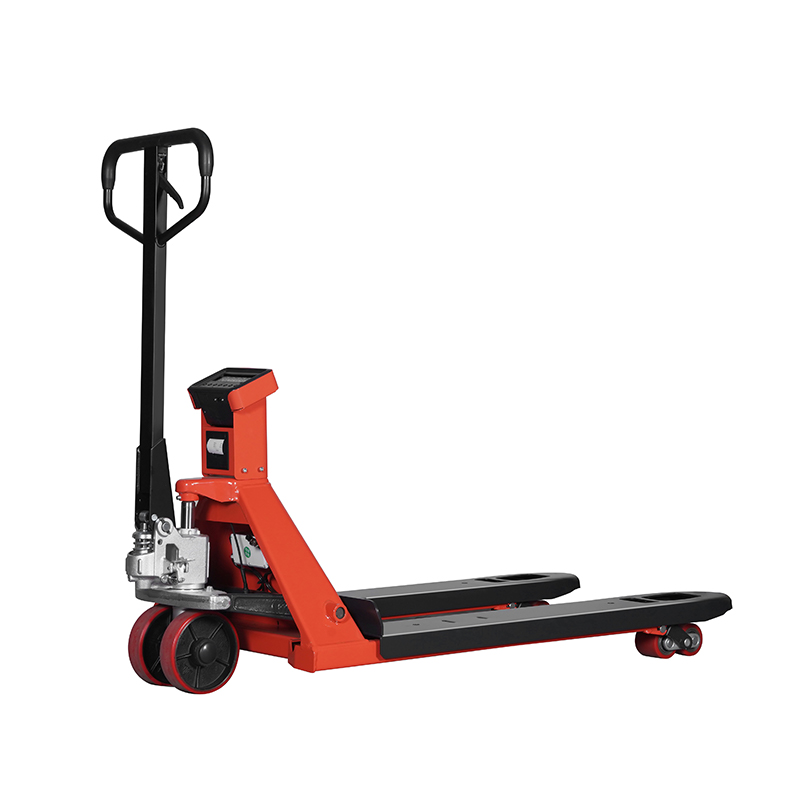
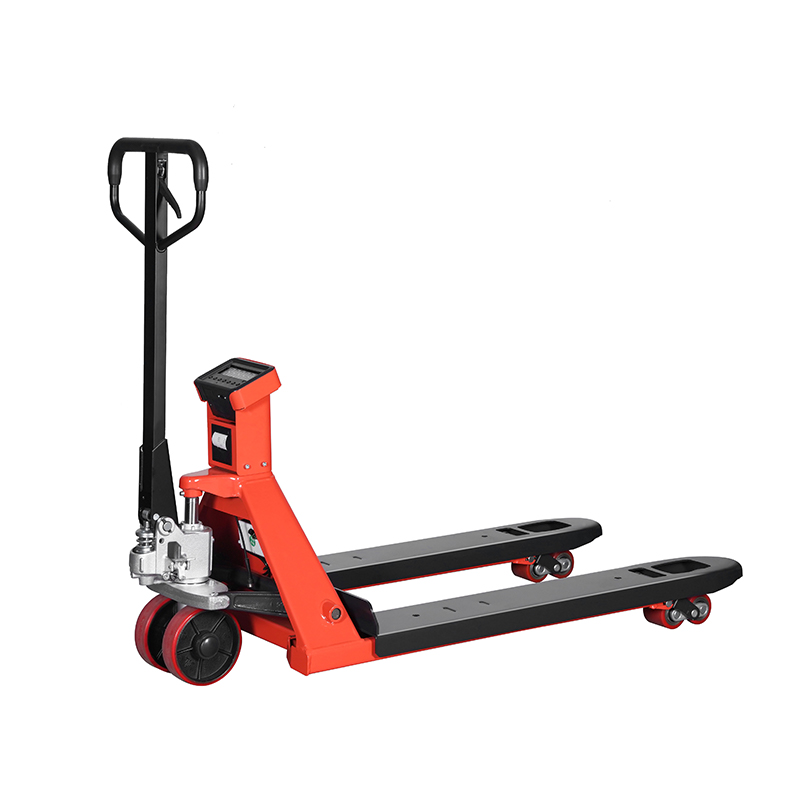 M20 Manual Weighing Pallet Truck with Digital IndicatorFor smaller sites and point-of-use checking, this manual truck combines handling, weighing, and counting with an IP54 sealed waterproof design and clear digital readout.View Product →
Whichever route you take, confirm capacity, graduation and the calibration routine in writing before the truck reaches the floor.
Frequently Asked Questions
Q1: How often should a scale pallet truck be calibrated?
A practical schedule is a full calibration every 6 to 12 months, a monthly zero and one-load verification, and immediate recalibration after any repair, impact or indicator change.
Q2: Can I calibrate a weighing pallet truck without certified test weights?
You can verify it roughly, but you cannot calibrate it. Accurate span calibration needs a known mass, and using an assumed weight copies its error into the scale permanently.
Q3: Why does my scale read differently at the fork tips than in the centre?
Off-centre loads bend the fork frame and excite the load cells unevenly. If the spread exceeds one graduation, inspect the frame for distortion and repeat the corner test after any impact.
Q4: What does three-proof mean on a weighing pallet truck?
Three-proof refers to water, dust and corrosion resistance in the sealing of the indicator, connectors and load cell. It matters in washdown, cold storage and chemical environments.
Q5: Why does the reading change when the battery is low?
Load cells need a stable excitation voltage. When the battery sags, the signal shifts and the display drifts, so rule out a low charge before touching the calibration.
Calibration is a routine, not a repair. Set the zero point on level ground, calibrate the span with certified weights, verify repeatability and corner loading, and log what you did. Troubleshooting then becomes a short process of elimination: mechanics, electrics, environment, and only then calibration.
Treated that way, a weighing pallet truck stops being a source of disputes and becomes what it was bought to be: a scale that travels with the load.